Jenang - Four Deities of Kadampa with commentary - Geshe Sonam Ngodrup
Translation from Tibetan to English by Venerable Khedrup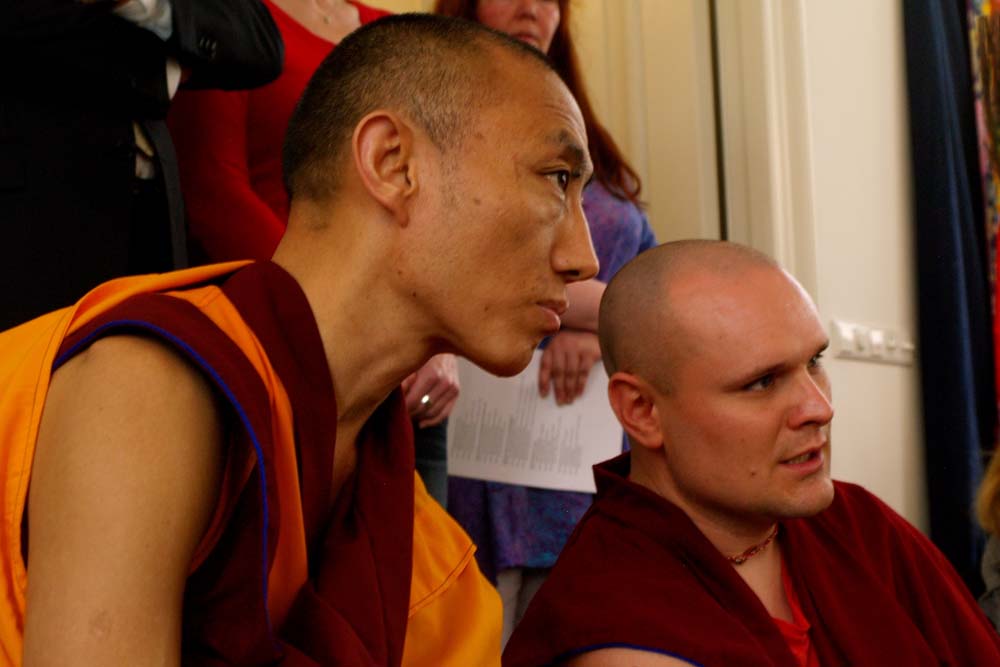
Geshe Sonam Ngodrup will be visiting the Netherlands in the beginning of May and has been so kind to offer teachings (Loenen) & empowerment and a Refuge ceremony (Amsterdam). Geshe la will grant a jenang (permission initiation) into the Kriyā tantra practices of the Four Deities of Kadampa. In the afternoon Geshe la will give a further introduction into the sadhana and will explain why tantra is so important for practitioners.
Four Deities of Kadampa
In Tibetan Buddhism, receiving an empowerment connects the practitioner’s mind with the
enlightened qualities of the Buddha through a living lineage. This is important because it:
- Creates a karmic connection with the deity and lineage masters.
- Permits and energizes the practice of the deity’s meditation and mantra.
- Plants the seed of enlightenment in the practitioner’s mind stream through receiving the blessings of the deity's holy body, speech, and mind.
- Transforms ordinary perception—helping the practitioner see their own mind as
inseparable from the awakened qualities of these deities.
In Kadampa practice, the Four Deities are often emphasized, because together they represent the complete path: wisdom, compassion, protection, and swift activity.
- Shakyamuni Buddha - Meditating on Shakyamuni Buddha connects us to the original source of the Dharma and develops faith, clarity, and wisdom.
- Acala - A wrathful protector deity whose name means “The Immovable One.” Acala represents spiritual strength and discipline, helping practitioners overcome inner afflictions such as anger, laziness, and doubt.
- Green Tara – This female Buddha embodies quick compassionate response, encouraging practitioners to develop fearless compassion and active altruism.
- Avalokitesvara - Meditating on Avalokitesvara develops bodhicitta—the wish to attain enlightenment for the benefit of all beings.
For whom
The initiation (jenang) can be received as:
- a blessing - This is possible for everybody.
- an empowerment - This means after the empowerment you are allowed to
engage fully with the practice through reciting the sadhanas.
Those who wish to receive this as a blessing do not need to take on any commitments. Those who wish to receive the initiation (jenang) must have gone for refuge to the Three Jewels and take the Bodhisattva Vows. For those who have not taken them before, the Bodhisattva Vows will be given in abbreviated form during the initiation. Those who have not previously taken Refuge and wish to, may do so in a ceremony the day before.
Geshe la asks that the day of the initiation students maintain a sattvic vegetarian diet: no meat, fish or eggs, plus avoidance of the five pungent plants: onion, garlic, leeks, chives, and scallions. These restrictions are relaxed after the initiation is completed.
About Geshe Sonam Ngodrup
“The positive approach, putting an emphasis on happiness instead of dwelling on fear and negativities too much, activates a wish to grow, to continue this path, and the way he offers the teachings with great patience and understanding for all that makes us human, make that this personal growth can take place, in his words, with a joyous effort. The dynamic with his translator, Ven. Khedrup is light and easy-going, and they are able to make one feel connected, both to them and to the teachings.” – student at Maitreya Amsterdam
Geshe Sonam Ngodrup was born in 1968 in the Ganze region of Kham, Tibet and left at the age of 13 to study Buddhism in India. He was ordained as a novice monk at Sera Jey Monastery that year, and at the age of 21 received full ordination from His Holiness the Dalai Lama.
Geshe la graduated as a Geshe Lharampa from Sera Jey Monastery in first position in 2003, and in 2004 completed a year of tantric studies at Gyumed Monastery in Hunsur. He was one of the most popular petri geygan (official scripture teachers) at Sera Jey with several hundred students, teaching complex topics of the monastic curriculum. In addition, Geshe la taught sutra studies at Dzongkhar Choede and Gyumed monasteries where his classes were in high demand.
In 2011, Geshe la came to the West, teaching the topics of the Basic Program first at Nalanda Monastery in France and then at Maitreya Institute in the Netherlands, in addition to courses on introductory Buddhism throughout Europe. In 2019, Geshe la settled in Canada. He is a well-loved teacher whose vast scriptural knowledge is tempered by a naturally humble nature and profound non-sectarian approach to the study of the teachings.
Gentle spoken advice by Geshe la
A series of inspiring short videos with advice from Geshe la can be found here on YouTube:
Dāna (generosity) is one of the cornerstones of the Buddhist path. By virtue of their generosity, the Buddha and the ordained sangha offer us the teachings, and in exchange, the lay community supports Dharma centers and the monastic community. This interdependence is essential for us to share the Dharma and continue our work to benefit all sentient beings. With your donation we support our teachers in their cost of living and we uphold our dharma center, which is fully dependent on donations and managed entirely by volunteers.
Donation
The suggested donation for this special day is €35. For students and people with low income, the suggested donation is €25. Please send us an email if you'd like to make use of this option. Keep in mind that the donation amount should never be an obstacle to your access to the Dharma. Please contact us if it might be an obstacle for you.
Ga terug